
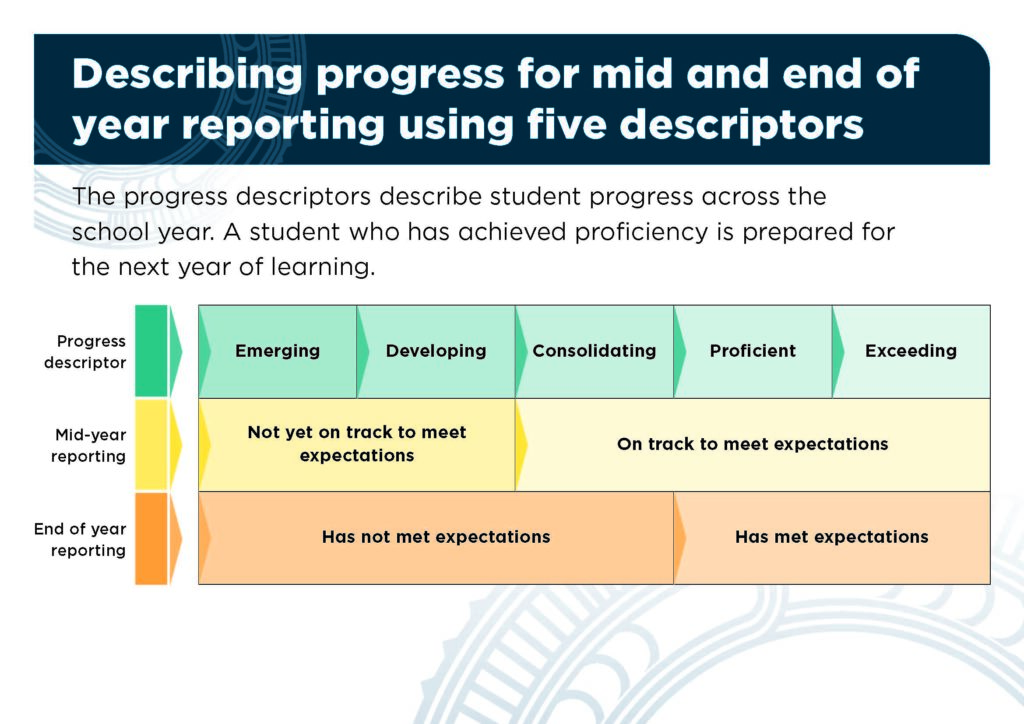
Progress descriptors are clear, nuanced, and positive, and help identify where a child is achieving, and what is needed to support further progress. At the end of the year, children who are proficient or above show they are ready for the next year of learning.
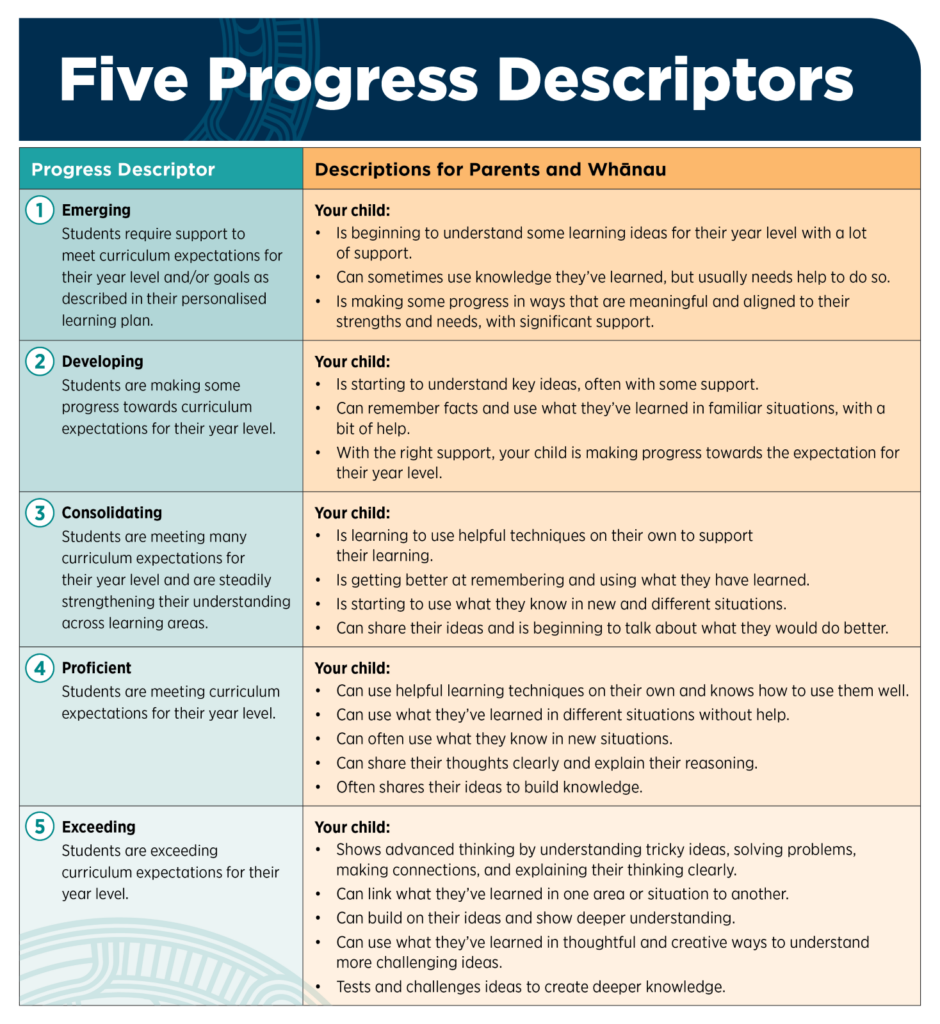
How teachers will select progress descriptors
Selecting the right descriptor involves professional judgement, evidence from multiple sources, and a well-rounded understanding of your child’s knowledge and capabilities.
No single piece of evidence can provide a teacher with the full picture of your child’s learning progress. A teacher will bring together multiple sources of information, to gain a clearer, more reliable understanding of your child’s progress and achievement.
This includes information from throughout the year from observations, conversations with students, tasks, and data from assessment tools (Phonics Check, e-asTTle, PATs, SMART).
What are PATs?
Progressive Achievement Tests (PATs) are a series of online assessments developed by the New Zealand Council for Educational Research (NZCER). Schools across Aotearoa use them in subjects like Reading, Mathematics, Listening, and Punctuation & Grammar.
Rather than being a “pass or fail” exam, PATs give our teachers a helpful snapshot of what your child currently knows and what their next steps in learning should be. When looking at PAT results, you will usually see two numbers: a Scale Score and a Stanine.
1. Scale Scores: Measuring Growth Over Time
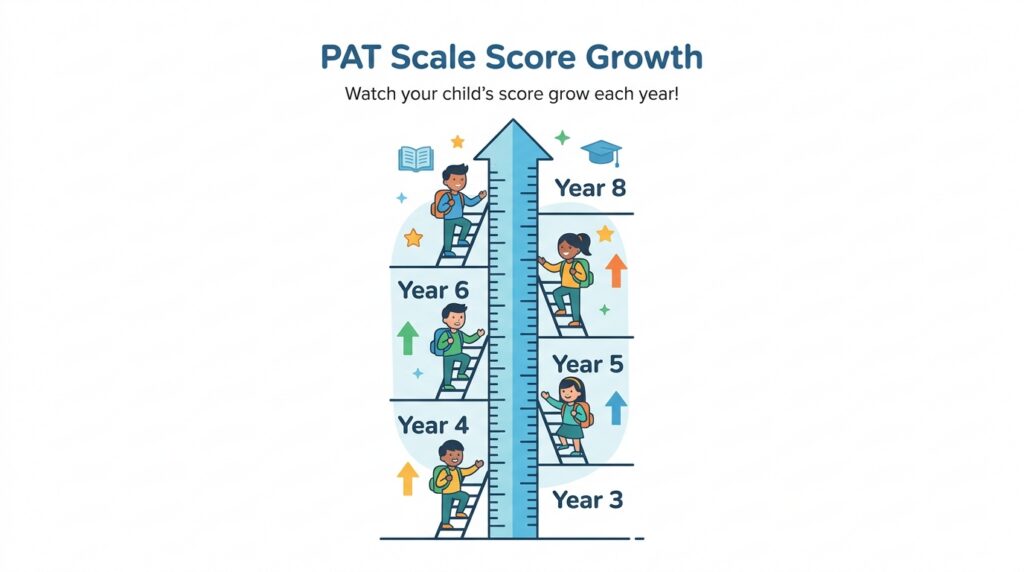
Think of a PAT Scale Score like a height chart on a doorframe.
- How it works: Everyone is measured on the exact same continuous ruler—from Year 3 right through to Year 10. For example, a PAT Mathematics scale score might look like 48.2 patm.
- What to look for: As your child learns and grows each year, you should expect their Scale Score to go up, just like their height does.
- Why it’s useful: Because the ruler stays the same every year, Scale Scores allow us to track your child’s personal progress from one year to the next—regardless of how other students performed.
2. Stanines: Comparing with Same-Year Students Nationally
While a Scale Score tracks your child’s personal growth over time, a Stanine (short for standard nine) compares your child’s result with other students in the exact same year level across New Zealand.
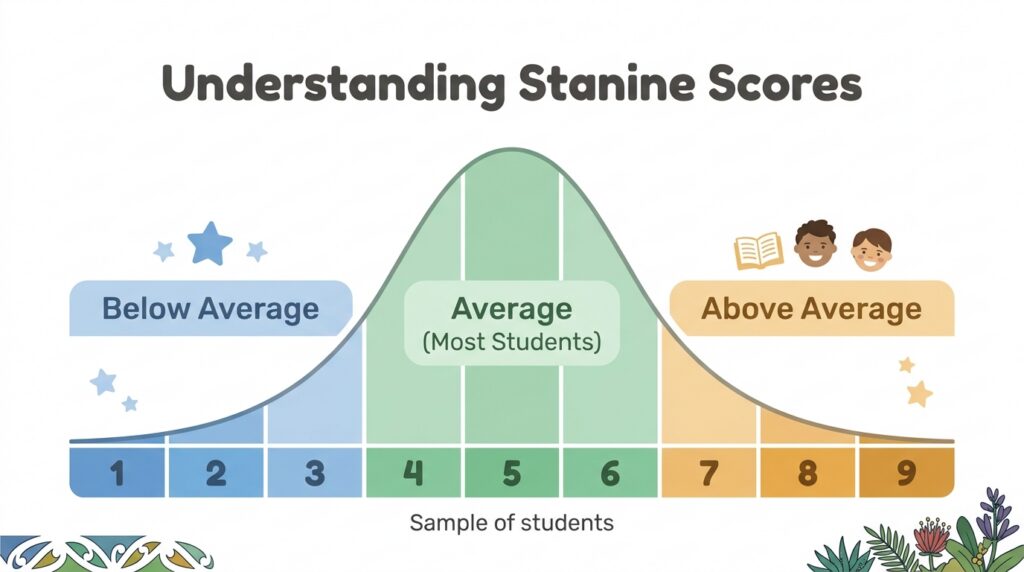
A helpful tip about Stanines: Because Stanines compare your child against peers who are also learning and growing every year, staying in the same Stanine from year to year actually means your child is making a full year’s worth of progress! If their Scale Score goes up and their Stanine stays steady (for example, staying at Stanine 5 from Year 4 to Year 5), they are growing right on track.
SMART ASSESSMENT RESULTS
SMART stands for the Student Monitoring, Assessment, and Reporting Tool. It is a free, Ministry of Education-provided online assessment tool designed specifically for New Zealand schools and aligned with the refreshed New Zealand Curriculum (Te Mātaiaho).
Teachers may use SMART to check in on student progress in core areas like Reading, Writing, and Mathematics & Statistics across Years 3 to 10.
How SMART Helps Your Child
- Pinpoints Next Steps: Rather than just giving an overall grade, SMART helps teachers see the specific concepts and skills your child has mastered—and where they might need a little extra support or extension.
- Built for Te Mātaiaho: Because SMART is aligned directly with the phases of learning in our national curriculum, it helps teachers make informed, consistent judgments about how your child is progressing.
- Tracks Growth Over Time: Teachers can use SMART at different points in the year to see how your child’s understanding is developing and to tailor classroom teaching to their needs.
Just like PATs, SMART is one helpful piece of the puzzle. It works alongside everyday classroom observations, learning conversations, and your child’s classwork to give a well-rounded picture of their learning journey.
On your child’s report, the SMART assessment result will be marked as one of the Progress Descriptors: Emerging, Developing, Consolidating, Proficient and Exceeding.
What is the Phonics Check?
The Phonics Check is a quick, Ministry of Education-provided assessment designed for our youngest learners (typically around 20 weeks and 40 weeks at school).
It is a simple, 1-on-1 activity with a familiar teacher that takes about 5 to 10 minutes. During the check, your child is asked to read a short list of words aloud—including both everyday words and fun “nonsense” (made-up) words.
Why do we use “nonsense” words?
- Checks True Decoding Skills: Because a child cannot simply memorise a made-up word by sight, nonsense words show us how well they are matching letters to sounds and blending those sounds together.
- Pinpoints Next Steps Early: It helps teachers celebrate what your child has already mastered and spot any specific letter-sound patterns they might need a little extra practice with right away.
How Will This Look on My Child’s Report?
Rather than giving a raw test score or a percentage, the result on your child’s report will be shown as one of the five Curriculum Progress Descriptors (such as Emerging, Developing, Consolidating, Proficient, or Exceeding).
Using a Progress Descriptor gives you a clearer, big-picture view of how your child’s early reading skills are developing in line with the New Zealand Curriculum (Te Mātaiaho).
Just like all our assessments, the Phonics Check is one helpful snapshot. Our teachers combine what they notice during this check with your child’s everyday reading, writing, and classroom conversations to support their literacy journey.
What does ‘No assessment results have been recorded’ mean on my child’s report?
You may see this phrase on your child’s report where you expect to see scores from tests like PAT, SMART, Phonics. Please do not worry. This simply means your child did not sit these specific standardised tests during the recent testing period. It does not mean your child is not being assessed or that we don’t know where they are at with their learning.
Here are the most common reasons why this message appears:
1. The Timing Didn’t Match Up
Standardised tests are usually done within specific “windows” during the year.
- New Entrants/Junior Students: If your child has just started school, they are often too young for these types of tests.
- New Students: If your child transferred to WPS from another school after the testing window closed, they won’t have results recorded in our system for that round.
2. They Missed the Test Day
These assessments are done on computers over several days. If your child was unwell, on holiday, or at an appointment during the days their class was tested, they will not have a result for that specific assessment.
3. The Test Wasn’t Right for Them Right Now
Sometimes, a teacher may decide that a particular standardised test is not appropriate for a child at that exact moment. For example, if a child requires specific learning support, English language learning support, or is experiencing high anxiety, the teacher will use other, more personal ways to check their progress.
4. We Use Different Evidence for Junior Classes
Our youngest learners (Years 1–3) are assessed primarily through daily observations, learning conversations, and hands-on activities. While we introduce some testing as they get older, formal standardised scores are not the main way we report progress for our newest tamariki.
How We Are Assessing Your Child
Even without these specific test results, our teachers build a rich picture of your child’s learning through:
- Daily Teacher Observations: Watching how they work and interact.
- Learning Conversations: Talking to your child about what they are doing and why.
- Book Work & Projects: Looking closely at the quality of what they produce in class.
- Other In-Class Assessments: Using smaller, targeted tools designed to show next steps in reading, writing, and maths.
If you ever have questions about your child’s results, please reach out to their classroom teacher—we are always happy to kōrero!